
EquipmentExplainer
Do Solar Panels Work in UAE Heat and Dust?
How 45°C heat, dust and humidity really affect solar output in the UAE, and the engineering that keeps systems producing year after year.
By Mujtaba Ali, Co-Founder & Director
5 min readLast reviewed

The short answer
Yes. Solar panels work in UAE heat: the country gets 2,100–2,300 kWh/m² of sunshine a year. Heat trims output on the hottest afternoons, and dust keeps lowering output if panels go uncleaned. Both are engineered for: a properly specified, regularly cleaned UAE system keeps producing year after year.
- annual solar irradiation in the UAE
- 2,100–2,300 kWh/m²
- yearly UAE yield, panels tilted on a villa roof
- 1,620–1,711 kWh/kWp
- yearly UAE yield, flat roof
- 1,517–1,602 kWh/kWp
On this page6 sections
- annual solar irradiation in the UAE
- 2,100–2,300 kWh/m²
- yearly UAE yield, panels tilted on a villa roof
- 1,620–1,711 kWh/kWp
- yearly UAE yield, flat roof
- 1,517–1,602 kWh/kWp
Does heat reduce solar output?
Solar panels convert light, not heat, into electricity, and here's the twist: panels actually prefer cold sunshine. Every panel has a "temperature coefficient" (typically around −0.3 to −0.4% per °C above 25°C on modern Tier-1 modules). On a UAE summer afternoon, a rooftop panel's cell temperature can hit 65–75°C, trimming instantaneous efficiency by roughly 12–18% versus its lab rating.
Sounds bad? Now the other side of the ledger:
- The UAE receives roughly 2,100–2,300 kWh/m² of solar irradiation annually.
- Summer days are long and essentially cloudless; the "heat tax" applies to an enormous base of light.
- Cooler months (November–March) deliver strong production: high sun, mild temperatures, minimal losses.
Net result: a UAE system yields about 1,517–1,602 kWh per kWp per year on a flat roof, and about 1,620–1,711 with panels tilted on a villa roof: far more than the same panels would produce in northern Europe. The UAE's heat tax is real; the UAE's light income dwarfs it.
The heat is a tax, not a threat. The dust is a bigger tax, and a fully refundable one.
What good engineering does about heat: panels selected for low temperature coefficients; mounting with ventilation gap so air cools the panel's underside; inverters, the component genuinely bothered by heat, placed in shaded, ventilated locations and sized so they're not running at redline through August. This is exactly the difference between a UAE-specified system and a catalog copy-paste.
- Temperature coefficient
- How much output a panel loses for each °C above 25°C: around −0.3% to −0.4% per °C on modern Tier-1 modules.
- output lost per °C above 25°C, modern Tier-1 modules
- −0.3 to −0.4%
- a rooftop cell on a UAE summer afternoon
- 65–75°C
- trimmed from instantaneous efficiency at that heat
- 12–18%
How much output does dust cost?
Dust doesn't damage panels. It just shades them: a particle at a time, every day, with almost no rain to help. Measured reality in the Gulf:
- A light film after a few dusty weeks: output starts to slip.
- A month or two uncleaned in a high-dust zone: the losses are much larger.
- The morning after a proper shamal: panels can look beige and lose more still.
The economics write themselves: professional cleaning costs a small fraction of the production it recovers, which is why every serious UAE system runs a cleaning schedule: monthly near open desert or construction, quarterly in irrigated communities. Panels are cleaned with water. (The one thing not to do: a pressure washer, invisible microcracks now, lost output years later.)
Design helps here too: panel tilt lets gravity and any rain shed dust; frameless or optimised-frame modules avoid dust dams at the lower edge; and monitoring catches soiling drift the eye misses, when actual output diverges from expected, the system literally tells you it's time for a wash.
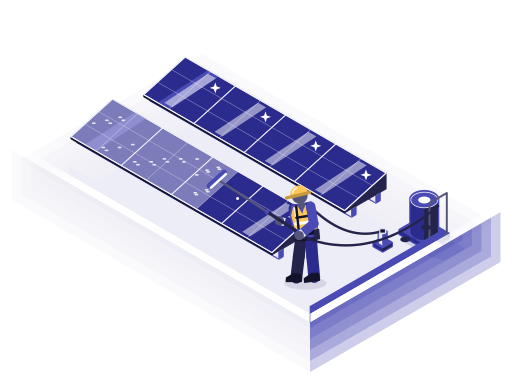
- Soiling
- Dust and grime on the glass that shades the cells and lowers output.

What do humidity and salt air do?
Two quieter climate factors, both engineering-solvable:
- Humidity creates morning condensation cycles and, combined with dust, a stubborn film (one more reason cleaning runs on a schedule, not on sight). It also stresses electronics: one more reason inverter placement matters.
- Salt air near the coast (and seriously on the East Coast) attacks cheap fasteners and frames. Marine-grade mounting, sealed connectors, and salt-mist-certified components (IEC 61701-rated) are standard specification within a few kilometres of the sea: ask any bidder if theirs are.

Can panels handle sandstorms and wind?
Panels are built for hail zones: tempered front glass rated for impacts far beyond anything a shamal throws. Mounting systems carry engineered wind-load calculations stamped for your site. In short: the storm is fine; clean the panels afterwards.
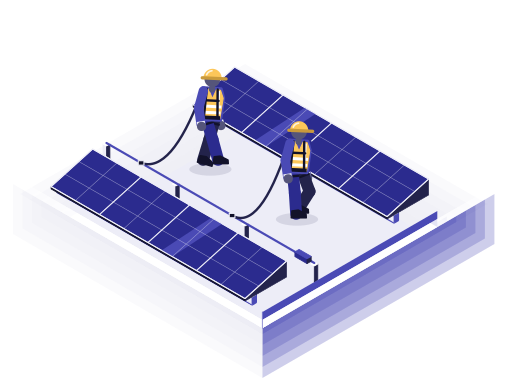
What do 25 years in the UAE look like?
Panels carry a 25–30 year performance warranty. Our estimates assume panel output falls 1% in the first year and 0.4% a year after. The realistic UAE maintenance ledger over 25 years: regular cleaning, one inverter replacement, and connector/cabling checks at annual inspections. That's the whole list.

How does each climate factor add up?
45°C heat
- Real impact
- −12–18% instantaneous on peak afternoons
- The fix
- Low-coefficient panels, ventilated mounting, shaded inverter
- Residual worry
- Priced into every serious production model
Dust
- Real impact
- Output lost steadily if ignored
- The fix
- Scheduled cleaning
- Residual worry
- None if maintained
Humidity
- Real impact
- Film + electronics stress
- The fix
- Scheduled cleaning with water, smart inverter placement
- Residual worry
- Minimal
Salt air
- Real impact
- Corrosion on cheap hardware
- The fix
- Marine-grade spec near coast
- Residual worry
- None if specified
Sandstorms
- Real impact
- Cosmetic; post-storm soiling
- The fix
- Post-shamal cleaning visit
- Residual worry
- None
UAE sunshine
- Real impact
- Far more yield than northern Europe
- The fix
- Enjoy
- Residual worry
- n/a
Keep reading
- Where Should You Buy High-Efficiency Solar Panels in the UAE?Where UAE homes and businesses buy Tier-1 high-efficiency solar panels, what high efficiency means on a roof, and why supply with installation matters.
ComparisonEquipment3 min readReviewed
- Which Solar Battery Suits a UAE Home or Business?When a battery pays its way in the UAE, what to check on the datasheet, and home vs business storage. Not offered for DEWA-connected sites in Dubai.
ComparisonEquipment4 min readReviewed
- Which Solar Panel Brands Suit UAE Heat?What makes a solar panel brand right for UAE heat and dust, which Tier-1 makers are common on UAE roofs, and how to check a model before you buy.
ComparisonEquipment4 min readReviewed


Want a system specified for this climate rather than a catalog's? That's the only kind we build.
Your bill has the answer. Calculate your savings now, or WhatsApp us your bill and a real person reads it. Then book your free site survey & energy check.