Skip to content
Solar Oasis

Battery Storage: Your Solar, After Sunset

Solar Oasis designs battery storage for homes and businesses. A battery stores daytime solar for use at night or during outages, so you also save in the evening and at night.

  • We size it to how much you use after sunset, from your bills.
  • Off‑grid: the battery covers the night, and an optional generator covers any shortfall.
  • We tell you honestly when you don't need one.

Battery, hybrid and off-grid systems are available in

By Mujtaba Ali, Co-Founder & Director. Last reviewed .

Abu Dhabi, Sharjah and the four Northern Emirates
6 emirates
carries lighting, a fridge, a router and fans through a whole evening
10 kWh
backup runtime for a typical essentials circuit
5–10 hrs

Do you need a battery?

Batteries are often misunderstood in UAE solar. Here's the straight version.

A battery isn't always the answer. If your home or business uses most of its power while the sun is up, a zero-export system (one that sends nothing to the grid) already offsets your daytime consumption, and a battery adds cost for little gain.

Hybrid (battery) and off-grid systems are available in Abu Dhabi, Sharjah and the Northern Emirates. Where a battery genuinely earns its place:

  • Backup security

    Clinics, home medical equipment, server rooms and refrigeration: anywhere an outage costs more than the hardware.

  • Evenings and nights

    Outside Dubai, systems are zero-export, so a battery is how the same roof keeps saving after sunset. It stores daytime solar so you also save in the evening and at night.

  • Homes with high evening use

    Air-conditioning, cooking and family time all land after sunset in most villas, which is when a battery does its daily work.

  • Businesses that run late

    Shops, clinics, restaurants and cold stores that trade into the evening use the battery every day, not once in a while.

  • Off-grid and remote sites

    On farms, majlis compounds, construction facilities and island properties, solar and batteries carry the daily load, and an optional generator tops up any shortfall.

  • Generator reduction

    Sites already running diesel can let solar and storage do the daily work, keeping the generator as last-resort backup instead of the daily workhorse.
Which battery systems does Solar Oasis design?

  • Hybrid systems

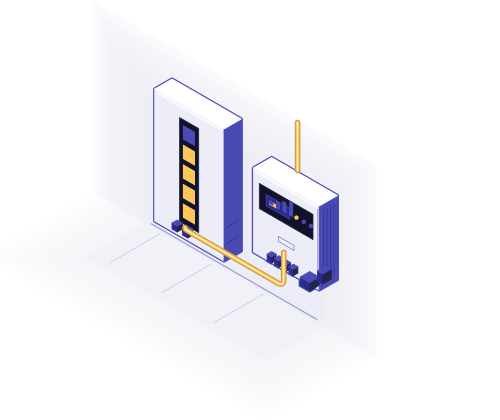
    Solar, battery and grid work together. The sun runs the day, the battery covers the evening peaks, the night and outages, and the grid backs everything else.

  • Backup (UPS-style) systems

    A protected circuit for the essentials: lights, fridge, router, medical devices, one AC zone. Seamless cutover, so an outage becomes a non-event.

  • Battery add-ons

    We add a battery to a system you already own, where its inverter allows it, or by adding a hybrid inverter alongside. Systems can be expanded later.

  • Off-grid systems

    The system runs completely off the grid: the battery covers the night, and an optional generator covers any shortfall. We design it around your load profile, with a day of battery autonomy (a full day's load from the battery alone).

Hybrid systems switch automatically between solar, battery and grid with an ATS (automatic transfer switch). Every design uses lithium iron phosphate (LFP) batteries rated for high outdoor temperatures, installed in ventilated, shaded enclosures. In the UAE, a battery's lifespan depends more on how it's kept cool than on how often it cycles, and we engineer for that.

Sizing, in plain numbers

A battery is sized by two questions: what must stay on? and how much do you use after sunset? Lighting, a fridge, a router and fans draw about 1–2 kW together, so 10 kWh carries them through a whole evening. Air-conditioning is a bigger load (one AC zone can draw 2–3 kW on its own), so we read your actual evening use from your bills and show you what size covers it before you commit. Whole-home backup including AC needs substantially more capacity, and we show you where each dirham of it goes.

One Abu Dhabi villa, three waysAn AED 800 monthly electricity charge, through the site’s calculator.
  1. Solar only

    Zero-export: offsets your daytime consumption.

    of panels
    8 kWp
    of battery
    None

    First-year saving, a month

    ≈AED 306

  2. Evening battery

    About one evening's use, sunset to bedtime.

    of panels
    21 kWp
    of battery
    ≈28 kWh

    First-year saving, a month

    ≈AED 512

  3. Whole night

    Carries the home through the night.

    of panels
    21 kWp
    of battery
    ≈66 kWh

    First-year saving, a month

    ≈AED 778

A battery system is sized to the whole day’s use, so the array grows too: the step from one column to the next is panels and battery together. Estimates from the site’s calculator at TAQA’s expat villa rate (September 2026); the same comparison for your emirate and bill is in the calculator. Tentative estimate, depends on site conditions.

How this is worked out

Indicative, for a typical system. Assumes about 1,620–1,711 kWh per kWp a year for homes (tilted panels) and 1,517–1,602 for businesses, depending on emirate, published utility tariffs (as of September 2026) rising 3% a year, panel output falling 1% in year 1 and 0.4% a year after, and the electricity charge or kWh you enter (not water, sewerage or housing fees). Savings are a share of the electricity charge, shown with VAT as on your bill. Prices excl. VAT; home paybacks include the 5% VAT a household pays. Utility approvals included; municipality fees and NOCs excluded. Your survey-based proposal is fixed.

What batteries cost

Storage is quoted per site: the battery's capacity in kWh and the hybrid or backup inverter set the price. A battery earns its place where it does a real job: backup value, evening and night savings on a zero-export roof, diesel displacement, or an off-grid site. We size it to that job, and if the honest answer is that you don't need one, that's the answer you'll get.

Send one bill: we tell you honestly whether a battery fits.

FAQs

All 47 questions →

Hybrid (battery) and off-grid systems are available in Abu Dhabi, Sharjah and the Northern Emirates: Ajman, Umm Al Quwain, Ras Al Khaimah and Fujairah.

A 10 kWh battery runs a typical essentials circuit (1–2 kW) for 5–10 hours. Whole-home backup with AC requires substantially more capacity: we size from your real loads.

Hybrid systems switch automatically between solar, battery and grid with an ATS (automatic transfer switch). You don't have to do anything: the sun runs the day, the battery takes over in the evening, and the grid covers whatever is left.

It depends on how much you use after sunset. We read your evening and night use from your bills and size the battery to it, so you aren't paying for capacity you never use.

Tell us what can't lose power and how you use power after sunset. We'll size the battery to it.

Send one bill: we tell you honestly whether a battery fits where you are.