Resorts & hospitality
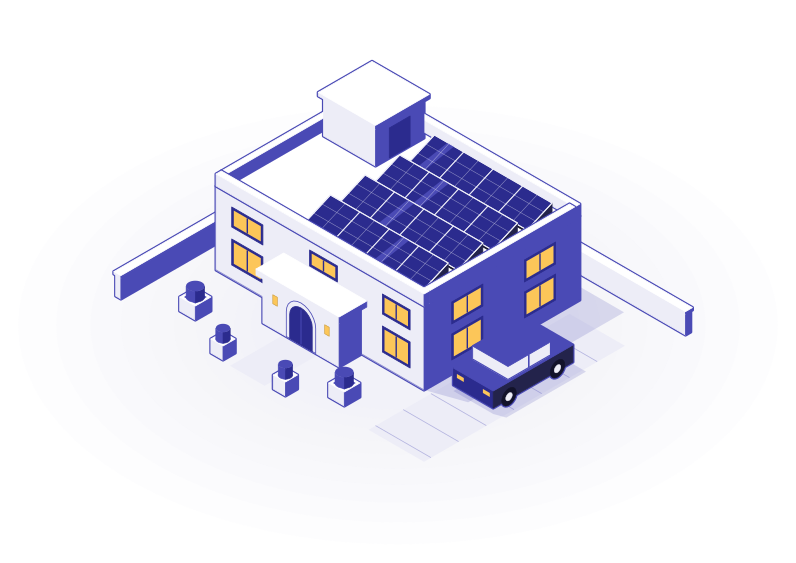
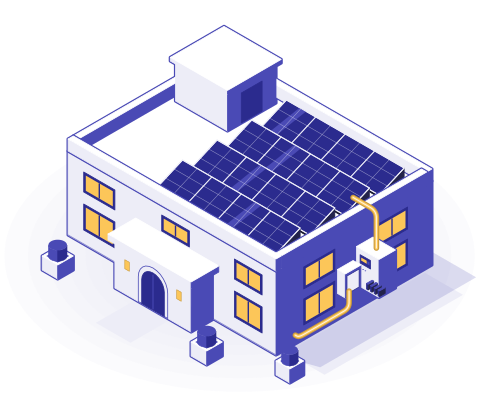
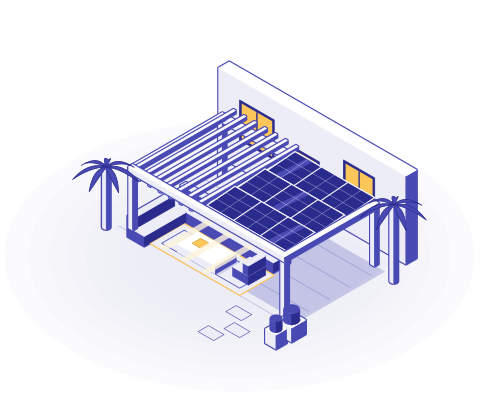
beachfront properties from Al Aqah to Dibba where sustainability sells rooms and daytime loads (pools, chillers, laundry) match production: visible commitment plus real savings.

Solar Oasis installs solar in Fujairah under EtihadWE, the utility serving the northern emirates, with systems built to its requirements.
Source: EtihadWE published tariff, as of September 2026. By Basheer Ansari, Managing Director & Co-Founder. Last reviewed .
The rates as EtihadWE publishes them. The higher your bill, the more of it sits on the top steps, and those are the units a daytime system takes off first.
Homes and businesses · kWh a month, + 5 fils fuel surcharge
Industry · flat rate, + 4 fils fuel surcharge
Fujairah accounts sit with EtihadWE. Systems here are zero-export, with hybrid (battery) and off-grid options. The engineering, though, is East Coast-specific:
EtihadWE does not offer net metering today. We build every system to its DSS standards, so if a net-metering policy is introduced, the system can be connected without being rebuilt.
The Gulf of Oman coastline is a corrosive, salt-laden environment, so mounting, connectors and hardware are specified for coastal sites where needed.
In wadis and foothill districts, the Hajar range clips early or late sun. We model your site's actual solar window, not a flat-desert assumption, before promising a single kilowatt-hour.
ventilation-aware layouts protect inverters that would quietly derate in sealed, humid enclosures.
EtihadWE's homes and businesses pay 23 to 38 fils per kWh as use rises, plus a 5 fils fuel surcharge; industry pays a flat 40 fils, with its own 4 fils fuel surcharge.
Businesses that run mostly in the daytime (typically around 8 am to 5 pm) use most of their solar as it's produced, which is where zero export saves the most.
Grid-connected systems are capped at 1 MW under DEWA and EtihadWE rules; off-grid systems have no such cap.*
Under EtihadWE's DSS, the 10% of connected load (max 1,000 kW) is a ceiling, not the system size.
beachfront properties from Al Aqah to Dibba where sustainability sells rooms and daytime loads (pools, chillers, laundry) match production: visible commitment plus real savings.
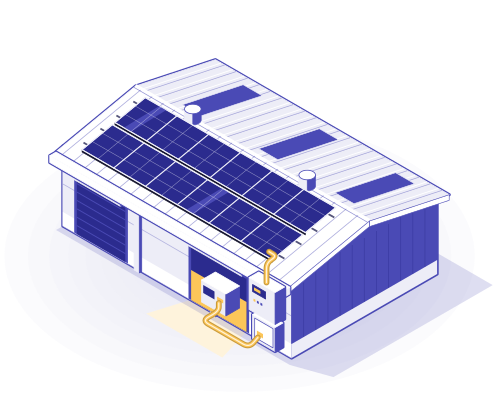
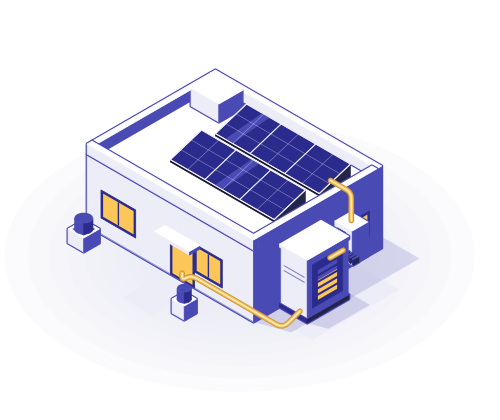
Fujairah's port, bunkering, and free-zone facilities run refrigeration, pumping, and workshop loads all day: C&I solar.
residential systems in Fujairah city, Dibba Al-Fujairah, and the Kalba-border districts.
where grid supply thins out, off-grid designs replace generator hours.
The full journey:
bill analysis under your EtihadWE tariff
system design with real shading modelling
installation by our team
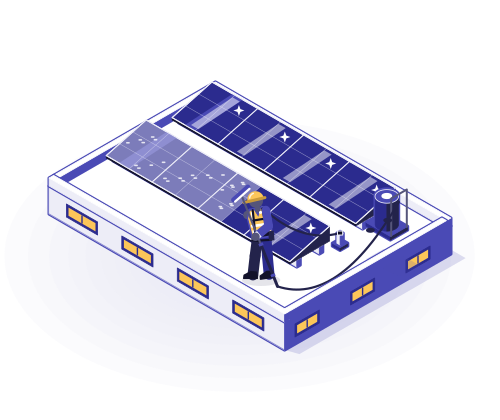
monitoring and maintenance on a coastal cleaning schedule
What you save on the East Coast depends on your system size and consumption profile: daytime-heavy operations and larger villa systems have more to offset; we show your specific maths before you commit.
Estimates from the site’s estimator at EtihadWE’s homes tariff (September 2026), zero-export. Mountain shading is modelled per site, from your coordinates, before we quote; the real number is your bill’s. Tentative estimate, depends on site conditions.
Indicative, for a typical system. Assumes about 1,620–1,711 kWh per kWp a year for homes (tilted panels) and 1,517–1,602 for businesses, depending on emirate, published utility tariffs (as of September 2026) rising 3% a year, panel output falling 1% in year 1 and 0.4% a year after, and the electricity charge or kWh you enter (not water, sewerage or housing fees). Savings are a share of the electricity charge, shown with VAT as on your bill. Prices excl. VAT; home paybacks include the 5% VAT a household pays. Utility approvals included; municipality fees and NOCs excluded. Your survey-based proposal is fixed.
Your Fujairah number, from one bill.
What solar really costs in the UAE → Indicative all-in prices, what moves the price, and the payback maths.