
Approvals and rulesStep by step
How Does Shams Dubai Approval Work, Step by Step?
Every step of DEWA's Shams Dubai process, from eligibility and NOCs to net metering, timelines and costs, explained in plain English.
By Basheer Ansari, Managing Director & Co-Founder
6 min readLast reviewed

The short answer
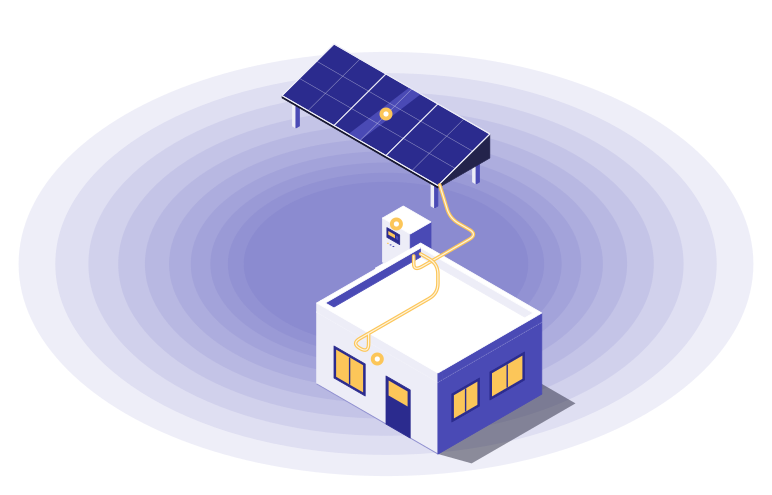
Shams Dubai is DEWA's programme for connecting rooftop solar to Dubai's grid under net metering. A villa goes through seven steps: feasibility, appointing a contractor, the community NOC, DEWA design approval, installation, DEWA inspection with a bidirectional meter, then billing with net metering. The community NOC is usually the step that sets the timeline.
- from the first bill to net-metered billing
- 7 steps
- Free: site survey & energy check.
- All-in: utility approvals included in our price.
On this page6 sections
- from the first bill to net-metered billing
- 7 steps
- Free: site survey & energy check.
- All-in: utility approvals included in our price.
What is Shams Dubai?
Launched under the Dubai Clean Energy Strategy (100 per cent of its energy requirements from clean sources by 2050), Shams Dubai lets buildings generate their own solar power while staying connected to DEWA's grid. The commercial heart of it is net metering: a bidirectional meter counts what you import and what you export, and your exports offset your imports on the bill. Sunny-afternoon overproduction effectively pays for your night consumption.
Three ground rules shape everything else:
- Grid-connected villas. In Dubai we design villa systems for net metering and don't offer batteries there: the grid is your storage. Hybrid (battery) and off-grid systems are available in Abu Dhabi, Sharjah and the Northern Emirates: see battery storage.
- Enrolled professionals only. Design and installation must be done by contractors enrolled with DEWA for Shams Dubai, using panels and inverters from DEWA's List of Eligible Equipment.
- Everything is inspected. DEWA verifies the installation against the approved design before connecting you. This is a feature: it's why a properly done Dubai system is a genuinely bankable asset.
- Net metering
- A bidirectional meter counts what you import and what you export; your exports offset your imports on the DEWA bill.
- Bidirectional meter
- The meter DEWA fits at connection, counting power both ways.
Who is eligible for Shams Dubai?
- Villa owners: the classic case. Any DEWA-billed villa with usable roof (or carport/pergola) space.
- Tenants: possible with the owner's signature on the application; the DEWA account holder and property owner both feature in the paperwork.
- Businesses: offices, warehouses, factories, schools on DEWA accounts; larger systems face additional engineering review.
- Apartments: individually no (the roof isn't yours); as a building/OA project, yes.
- NOC
- A No-Objection Certificate from your community or developer, issued before installation and paid by the owner.
How does the Shams Dubai process work?
Step 1: Feasibility
- You and the installer
- We aim to send your proposal within a week
A recent DEWA bill and satellite roof review answer most of the feasibility question: how much you consume, when, what your roof can host, and the projected savings and payback. A serious provider shows you the maths before asking for a dirham.
Step 2: Appoint your contractor
- You
Under Shams Dubai, DEWA's rules require design and installation by a contractor enrolled with DEWA, using panels and inverters from DEWA's List of Eligible Equipment.
Every system is designed to your utility's current rules: DEWA, SEWA, TAQA or EtihadWE.
Step 3: Community NOC
- Your community
- Timeline set by the community
If your villa sits in a master community, the developer or community issues a No-Objection Certificate (NOC) before installation. Each community sets its own forms and turnaround, and the NOC is paid by the owner. Standalone plots typically skip this step.
The community NOC, not DEWA, is usually the step that sets your timeline.
Step 4: DEWA application & design approval
- The installer and DEWA
- Review time set by DEWA
The application is filed with DEWA with system drawings, equipment datasheets (from DEWA's List of Eligible Equipment) and the electrical design. DEWA reviews it against Shams Dubai standards and sets its own review time.
Step 5: Installation
- The installer
Mounting, panels, inverter, cabling, protection: built exactly to the approved design (deviations mean re-approval; good contractors don't deviate). Installation typically takes 2–4 weeks once we start on site.*
*Depends on the project size.
Step 6: Inspection & synchronization
- DEWA
- Set by DEWA
DEWA inspects the completed installation. Pass → DEWA replaces your meter with a bidirectional meter and authorizes connection. Your system synchronizes with the grid and starts generating.
Step 7: Billing with net metering
- You and DEWA
- Every bill after connection
Your bill now shows imports minus export credits. Credits roll forward against future consumption. You'll also get a monitoring app from the installer: production, consumption, savings, live.
- DEWA-enrolled contractor
- A contractor registered with DEWA for Shams Dubai design and installation..
- List of Eligible Equipment
- DEWA's published list of panels and inverters for Shams Dubai; each model is checked against it per project.
What does Shams Dubai cost?
- The system: priced all-in from your bill: the calculator gives an indicative price.
- Fees around the process: The price on your proposal is the price you pay: utility approvals included. Municipality fees and community NOCs are paid by the owner.
- Meter: the bidirectional meter swap is part of the connection process, and our proposal says exactly what is included.
- Municipality fees
- Fees set by the municipality. Like the community NOC, they are paid by the owner.
How long does it take?
Feasibility & proposal
- Typical target
- We aim to send your proposal within a week.
Community NOC
- Typical target
- set by your community
DEWA design approval
- Typical target
- set by DEWA
Installation
- Typical target
- Installation typically takes 2–4 weeks once we start on site.* *Depends on the project size.
Inspection & meter
- Typical target
- set by DEWA
- Who sets each time
- DEWA sets its review and inspection times; your community sets the NOC. Ours is the proposal and the installation.
What stalls a Dubai solar project?
- Starting installation before the NOC: communities can and do order removal. Never skip the sequence.
- Non-approved equipment: a bargain inverter not on DEWA's list fails design review; you'll pay twice.
- Undersized paperwork, oversized promises: quotes that ignore NOC drawings/fees look cheaper and finish slower.
- Design-vs-build drift: installing anything different from the approved drawings triggers re-approval at inspection.
- Forgetting the account details: the DEWA account name and the property owner must line up correctly in the application; tenancy cases need the owner's signature ready early.
Keep reading
- What Does Solar Cost in Each Emirate?We work out the savings maths from the tariffs in Dubai, Abu Dhabi and the Northern Emirates, and show what it means for your villa or business in 2026.
CostsCosts and incentives5 min readReviewed
- Do Solar Panels Work in UAE Heat and Dust?How 45°C heat, dust and humidity really affect solar output in the UAE, and the engineering that keeps systems producing year after year.
ExplainerEquipment5 min readReviewed
- How to Choose a Commercial Solar Provider in the UAEA checklist for choosing a commercial solar provider in the UAE: proven systems, named components, utility approvals, an honest savings model and aftercare.
ComparisonChoosing an installer4 min readReviewed


Thinking about Shams Dubai for your villa? Start with one bill.
Your bill has the answer. Calculate your savings now, or WhatsApp us your bill and a real person reads it. Then book your free site survey & energy check.